
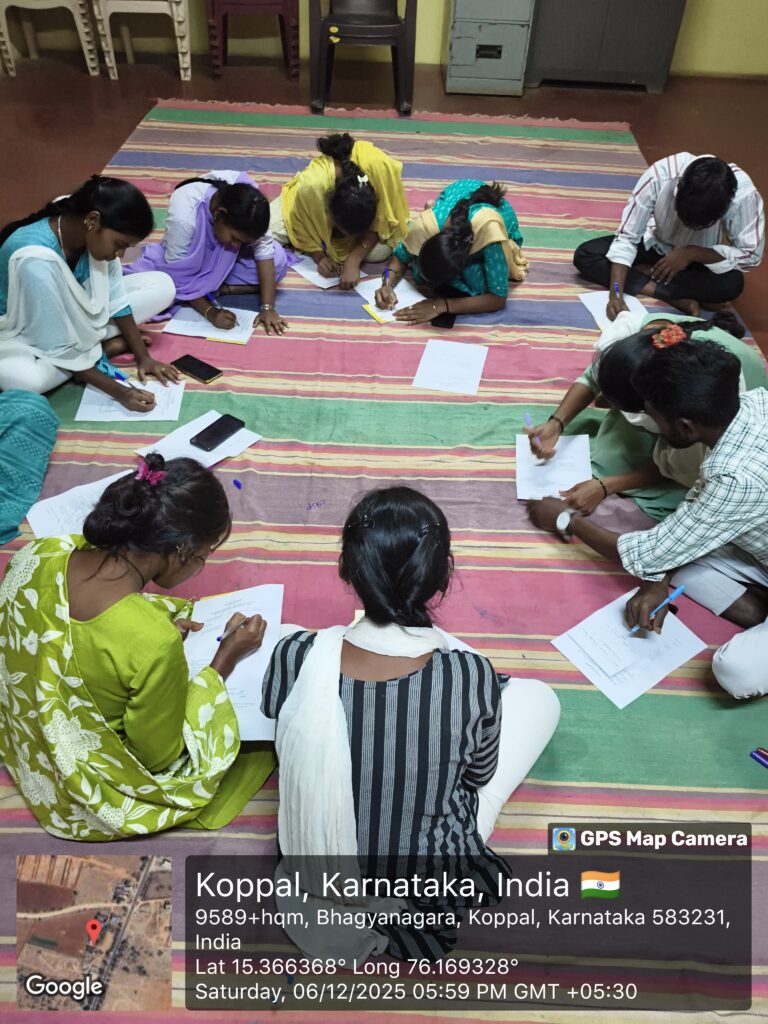
Programme Title: Youth as Active Citizens of Local Democracy
Basic Module VI: Participation and Accountability
Place: Samuha Samarthya, Koppal District, Karnataka
Dates: 05 & 07 December 2025
Partners: Neralu Society, ALFA, Angala
Resource Persons: Salima Jaan, Mahalaxmi
Participants: 29 Youth (12 Male, 17 Female)
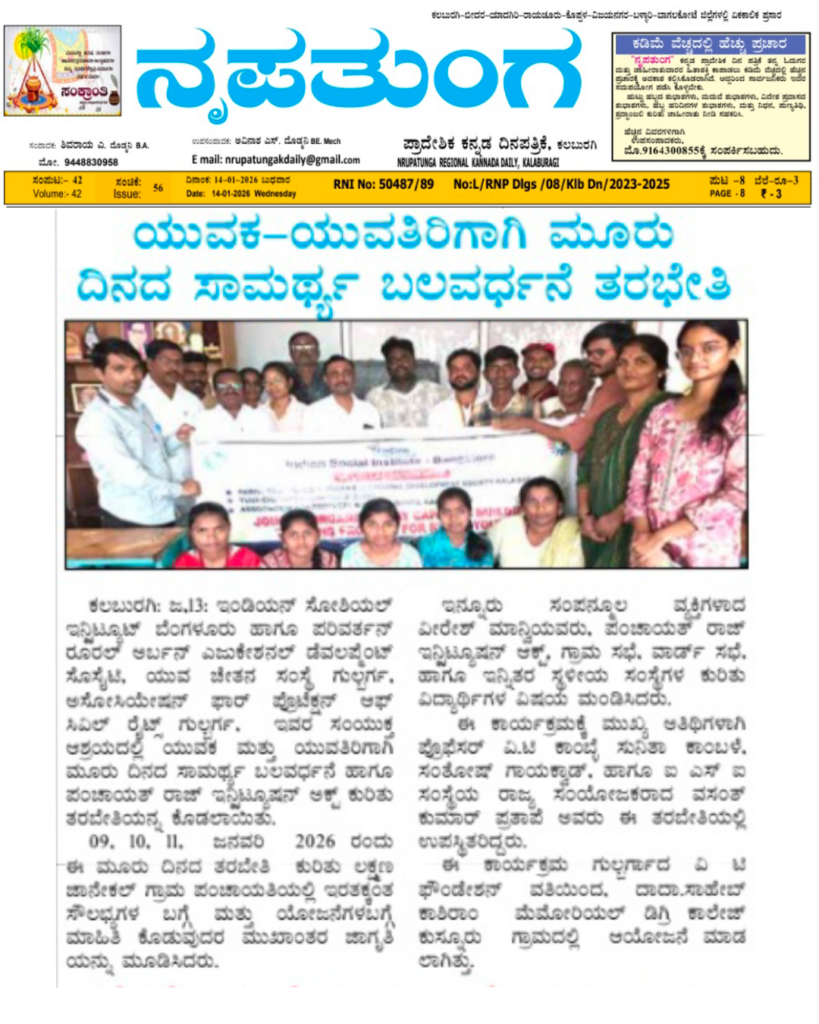
This three-day capacity-building programme was impactful in strengthening the democratic consciousness of rural and tribal youth in Koppal district by deepening their understanding of the Panchayat Raj Act, decentralisation, and people’s participation. The training aimed not only to build knowledge, but also to inspire young people to claim their rights, fulfil their social responsibilities, and actively engage in village governance.
The participants were encouraged to reflect on their personal relationship with Gram Panchayats, how often they engage with them, and how these institutions can be used to address everyday issues in their lives and communities.
Ms Salima Jaan, resource person led an engaging session on the Panchayat Raj Act, 1992, linking it with the Directive Principles of State Policy and the historic 73rd Constitutional Amendment. Youth gained clarity on the functions of Panchayats, the use of public funds, and the importance of transparency and participation through Gram Sabha and Ward Sabha meetings. The session also helped participants understand the coordinated role of government departments ensuring basic services such as healthcare, sanitation, vaccinations, education, and child protection. This holistic perspective helped youth see governance not as a distant system, but as a network they can actively access and influence.
Day Two sessions moved learning beyond the classroom. Participants attended a Gram Sabha at Mattura, held at the Government Higher Primary School, Tigari. Youth, including girl students, actively raised questions on drinking water, school infrastructure, sanitation facilities, stray animal management, and the need for sanitary pads for adolescent girls.
This real-life exposure strengthened confidence among participants, who directly interacted with the Panchayat Development Officer and witnessed democratic dialogue in action.
Further visits to Katarki and Gudlanur Gram Panchayats offered powerful examples of digital libraries supporting student success, women tractor drivers leading waste collection, and effective outreach of schemes to SC/ST communities. These examples served as living role models of people-centred governance.
Resource person Mahalaxmi highlighted grievance redressal tools such as Ward Meetings, Child Rights Meetings, social audits, and complaint mechanisms, motivating youth to address issues locally and become change agents in their villages.
On the final day Subhan and Vasanthkumar explained the Right to Information (RTI) process. Participants learned how to file RTI applications, seek information under Sections 6(1) and 7(1).
Mallika, youth participant shared, “This knowledge will guide us throughout our lives. Especially, we girls must know our rights, education, and culture. Knowledge is power.”
The training created a visible shift from awareness to action. Youth participants emerged with greater confidence to attend Gram Sabhas, access welfare schemes, and use constitutional remedies for justice and accountability.
Vasanthkumar P
Facilitator – Karnataka
Social Inclusion and Democracy Unit